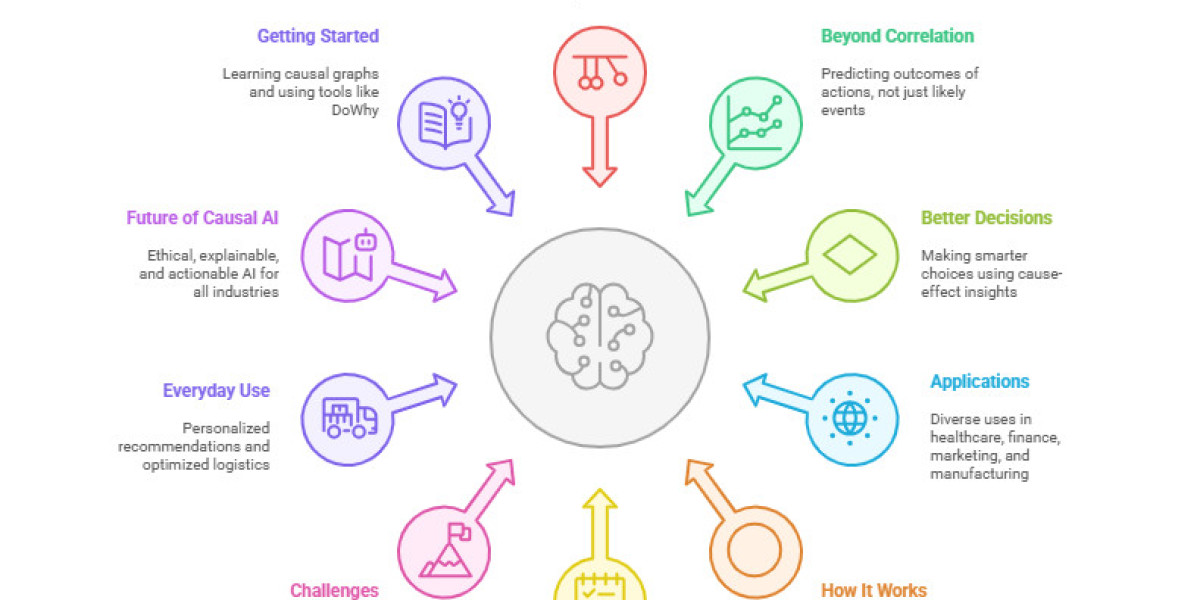

The advent of Causal AI marks a pivotal evolutionary step in artificial intelligence, moving beyond pattern recognition to a genuine understanding of cause-and-effect relationships, a shift that is creating a profoundly valuable new market. A thorough assessment of the Causal AI Market Valuation reveals an industry whose financial worth is rooted in its ability to empower organizations with true decision-making intelligence. Unlike traditional machine learning models that excel at identifying correlations—which can often be spurious or misleading—Causal AI seeks to answer the fundamental question of "why" an event occurs. This capability allows businesses to move from reactive prediction to proactive intervention. The market's valuation is therefore a reflection of the immense economic impact of making better, more informed decisions across a multitude of domains. For instance, in retail, it can determine the precise impact of a marketing campaign on sales, untangled from confounding factors like seasonality. In finance, it can model the true causal drivers of market risk, leading to more robust investment strategies. The premium placed on this technology stems from its potential to deliver a quantifiable return on investment by optimizing resource allocation, mitigating risks, and uncovering growth opportunities that are invisible to correlation-based systems.
The substantial valuation of the Causal AI market is further amplified by its role as a critical enabler of responsible and trustworthy AI. As AI systems become more autonomous and are deployed in high-stakes environments like healthcare and autonomous vehicles, the need for transparency, fairness, and robustness is paramount. Traditional "black box" AI models, which learn patterns from historical data, are often brittle and can fail spectacularly when confronted with new scenarios not seen in their training data. Causal AI addresses this fundamental limitation by building models that represent the underlying causal mechanisms of a system. This makes them inherently more robust to changes in the environment and less susceptible to perpetuating historical biases present in the data. The ability to conduct counterfactual reasoning—asking "what if" questions to explore the potential outcomes of different actions—is a key feature that contributes to its high valuation. This capability is invaluable for strategic planning, allowing leaders to simulate the impact of potential decisions before they are implemented in the real world, thereby de-risking innovation and policy-making. The market's worth is thus tied to its capacity to build safer, more reliable, and ethically sound AI systems.
Furthermore, the market's financial valuation is supported by the expanding ecosystem of software platforms, development tools, and specialized consulting services that are emerging around this technology. The value chain extends beyond the core algorithms to include platforms that facilitate causal discovery (the process of identifying causal relationships from data), tools for building and validating causal graphs, and applications that allow business users to interact with these models through intuitive interfaces. This growing infrastructure is lowering the barrier to entry, enabling a broader range of companies to leverage the power of causal reasoning without needing a large team of PhD-level data scientists. The valuation encompasses the revenue generated by specialized startups offering end-to-end Causal AI platforms-as-a-service, as well as the value being created by major cloud providers who are beginning to integrate causal inference capabilities into their broader AI and machine learning offerings. As the technology matures and becomes more accessible, its adoption is set to accelerate, driving further investment and solidifying the high valuation of a market that promises to fundamentally reshape how organizations use data to make decisions.
Top Trending Regional Reports -
Japan Field Service Management (FSM) Market